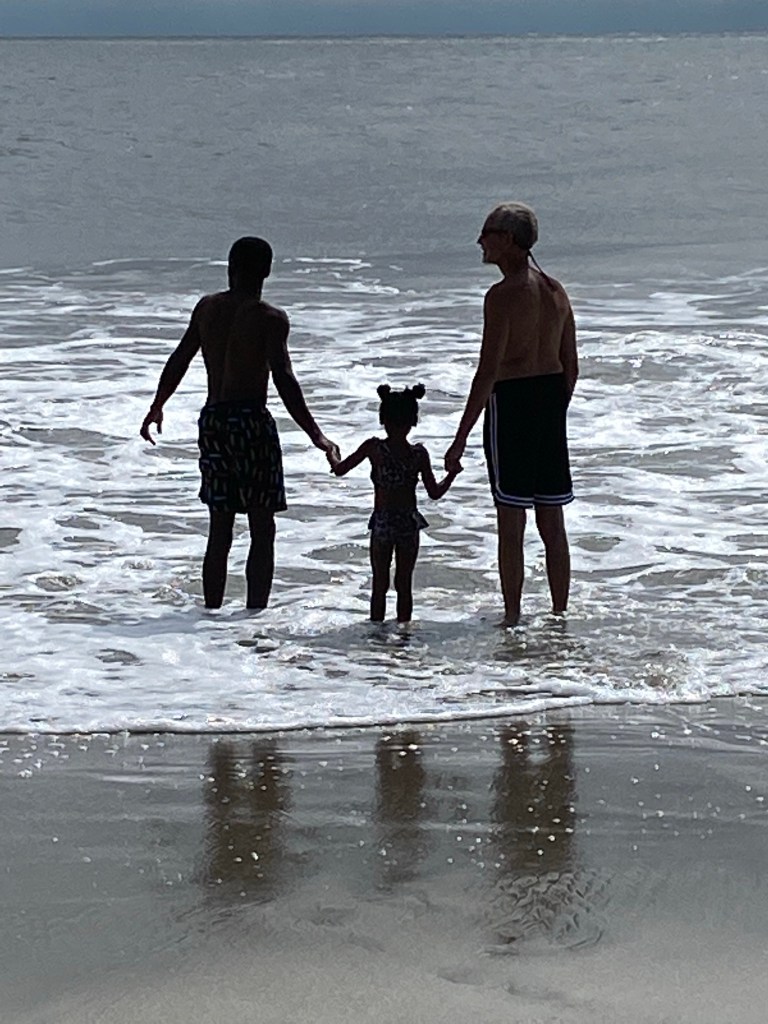
7.26.2021 – silhouettes black dark

silhouettes black dark
against the sun shinning low
shadows on the sand

Part of a series based on an afternoon spent at the beach on Hilton Head Island.

I wanted to see if I would be ‘inspired’ by what I saw, by what I heard, by what I smelled, by what I tasted, what I felt emotionally and what I felt tactilely.

Some turned out okay.

Some were too forced.

Some were just bad.

Some did involve some or all of those feelings.

As far as it goes, I guess I was inspired by by what I saw, by what I heard, by what I smelled, by what I tasted, what I felt emotionally and what I felt tactilely.

Click here for more Haiku in the BEACH category —

7.25.2021 – remains aware how

remains aware how
complicated lives can become
easily give up

Adapted from the book, A Week at the Airport: A Heathrow Diary (2009, Vintage Books) by Alain de Botton, and the passage:

I admired the optimism with which Dudley confronted every new pair of shoes that paused at his station. Whatever their condition, he imagined the best for them, remedying their abuses with an armoury of brushes, waxes, creams and spray cleaners. He knew it was not evil that led people to go for eight months without applying even an all-purpose clear cream polish. He was like a kindly dentist who, on bringing down the ceiling-mounted halogen lamp and asking new patients to open their mouths (‘Let’s have a look in here, shall we?’), remains aware of how complicated lives can become and so how easily people may give up flossing their teeth while they try to save their companies or minister to a dying parent.

Part of the series of Haiku inspired by from A Week at the Airport: A Heathrow Diary (2009, Vintage Books) by Alain de Botton. I discovered this book entirely by accident. When searching for books online, I will use the term ‘collections’ and see what turns up. I figure that someone who has taken the time to gather together the etexts of any one author to create a collected works folder is enough for me to see what this author might be all about.

In this case I came across the writing of Alain de Botton. I enjoyed his use of language very much. Much of the words he strings together lend themselves to what I do.

As for his book, I recommend it very much though written in 2009, it misses the added layer of travel under covid but still the picture of the modern airport is worth the read.

7.24.2021 – dominant impulse

dominant impulse
encountering beauty wish
to hold on to it

Adapted from the book, The Art of Travel (2002, Vintage Books) by Alain de Botton, and the passage:

A dominant impulse on encountering beauty is to wish to hold on to it, to possess it and give it weight in one’s life. There is an urge to say, ‘I was here, I saw this and it mattered to me.’

But beauty is fugitive, being frequently found in places to which we may never return or else resulting from rare conjunctions of season, light and weather.

How then to possess it, how to hold on to the floating train, the halvalike bricks or the English valley?

The camera provides one option. Taking photographs can assuage the itch for possession sparked by the beauty of a place; our anxiety over losing a precious scene can decline with every click of the shutter.

According to the website, GOOD READS, Any Baedeker will tell us where we ought to travel, but only Alain de Botton will tell us how and why.

As I said in the section on Architecture , what I find irresistible in reading Mr. de Botton is his use of language.

I get the feeling that if you made a spread sheet of all the words, adverbs and adjectives used by Mr. de Botton, you just might find that he used each word just once.

Neat trick in writing a book.

If I knew how to do that, hey, I would.

** More from the category TRAVEL — click here

7.23.2021 – power of the scene

power of the scene
appeared located in the
effect of the night

Adapted from the book, The Art of Travel (2002, Vintage Books) by Alain de Botton, and the passage:

I began word-painting.

Descriptive passages came most readily: the offices were tall; the top of one tower was like a pyramid; it had ruby-red lights on its side; the sky was not black but an orangey-yellow.

But because such a factual description seemed of little help to me in pinning down why I found the scene so impressive, I attempted to analyse its beauty in more psychological terms.

The power of the scene appeared to be located in the effect of the night and of the fog on the towers.

Night drew attention to facets of the offices that were submerged in the day.

Lit by the sun, the offices could seem normal, repelling questions as effectively as their windows repelled glances.

But night upset this claim to normality, it allowed one to see inside and wonder at how strange, frightening and admirable they were.

The offices embodied order and cooperation among thousands, and at the same time regimentation and tedium.

A bureaucratic vision of seriousness was undermined, or at least questioned, by the night.

One wondered in the darkness what the flipcharts and office terminals were for: not that they were redundant, just that they might be stranger and more dubitable than daylight had allowed us to think.

Adapted from the book, The Art of Travel (2002, Vintage Books) by Alain de Botton.

According to the website, GOOD READS, Any Baedeker will tell us where we ought to travel, but only Alain de Botton will tell us how and why.

As I said in the section on Architecture , what I find irresistible in reading Mr. de Botton is his use of language.

I get the feeling that if you made a spread sheet of all the words, adverbs and adjectives used by Mr. de Botton, you just might find that he used each word just once.

Neat trick in writing a book.

If I knew how to do that, hey, I would.

** More from the category TRAVEL — click here
7.22.2021 – imperceptible

imperceptible
goodwill moves efficiency
to tangible warmth

Adapted from the book, A Week at the Airport: A Heathrow Diary (2009, Vintage Books) by Alain de Botton, and the passage:

But however skillfully designed its incentive structure, the airline could in the end do very little to guarantee that its staff would actually add to their dealings with customers that almost imperceptible measure of goodwill which elevates service from mere efficiency to tangible warmth. Though one can inculcate competence, it is impossible to legislate for humanity. In other words, the airline’s survival depended upon qualities that the company itself could not produce or control, and was not even, strictly speaking, paying for.

Part of the series of Haiku inspired by from A Week at the Airport: A Heathrow Diary (2009, Vintage Books) by Alain de Botton. I discovered this book entirely by accident. When searching for books online, I will use the term ‘collections’ and see what turns up. I figure that someone who has taken the time to gather together the etexts of any one author to create a collected works folder is enough for me to see what this author might be all about.

In this case I came across the writing of Alain de Botton. I enjoyed his use of language very much. Much of the words he strings together lend themselves to what I do.

As for his book, I recommend it very much though written in 2009, it misses the added layer of travel under covid but still the picture of the modern airport is worth the read.