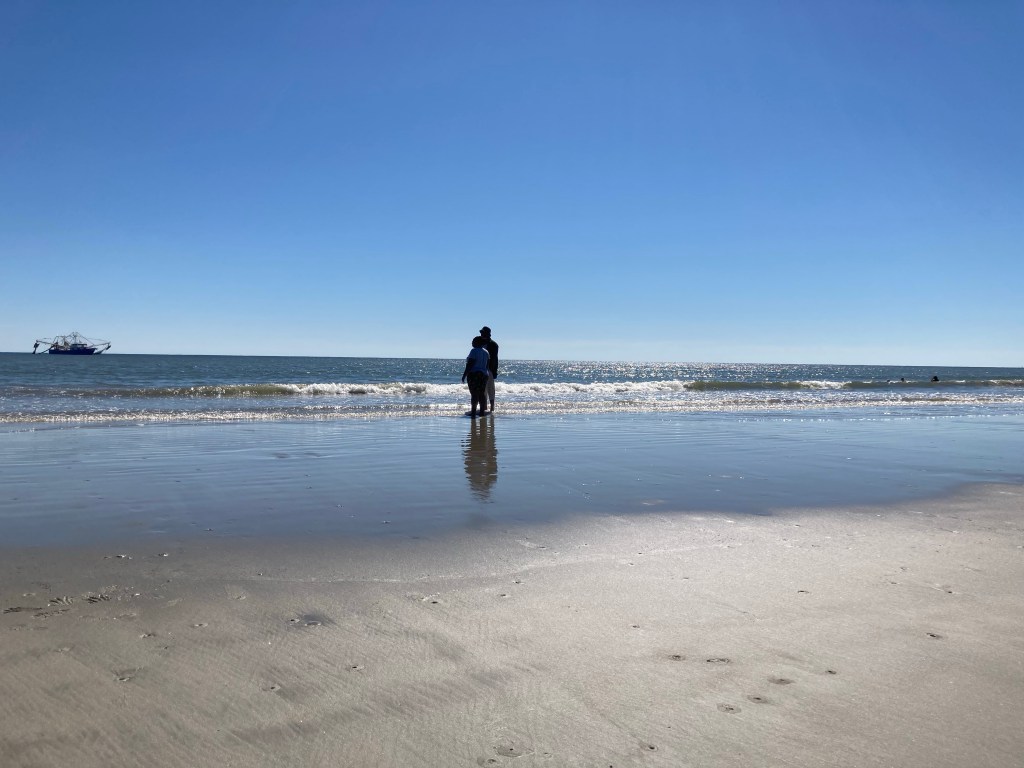
4.25.2021- silhouettes black dark

silhouettes black dark
against the sun shinning low
shadows on the sand

Part of a series based on afternoons spent at the beach on Hilton Head Island.

I wanted to see if I would be ‘inspired’ by what I saw, by what I heard, by what I smelled, by what I tasted, what I felt emotionally and what I felt tactilely.

Some turned out okay.

Some were too forced.

Some were just bad.

Some did involve some or all of those feelings.

As far as it goes, I guess I was inspired by by what I saw, by what I heard, by what I smelled, by what I tasted, what I felt emotionally and what I felt tactilely.

Click here for more Haiku from the BEACH

4.24.2021 – memory depends

may make the effort
of acquiring that knowledge
seem superfluous

Adapted from the book, The Art of Travel (2002, Vintage Books) by Alain de Botton, and the passage:

True possession of a scene is a matter of making a conscious effort to notice elements and understand their construction.

We can see beauty well enough just by opening our eyes, but how long this beauty will survive in memory depends on how intentionally we have apprehended it.

The camera blurs the distinction between looking and noticing, between seeing and possessing; it may give us the option of true knowledge, but it may also unwittingly make the effort of acquiring that knowledge seem superfluous.

Adapted from the book, The Art of Travel (2002, Vintage Books) by Alain de Botton.

According to the website, GOOD READS, Any Baedeker will tell us where we ought to travel, but only Alain de Botton will tell us how and why.

As I said in the section on Architecture , what I find irresistible in reading Mr. de Botton is his use of language.

I get the feeling that if you made a spread sheet of all the words, adverbs and adjectives used by Mr. de Botton, you just might find that he used each word just once.

Neat trick in writing a book.

If I knew how to do that, hey, I would.

** More from the category TRAVEL — click here

4.23.2001 – teach ideas can be

speaking of our, in their
dissociated language,
lives important themes

Adapted from the book, The Architecture of Happiness (2009, Vintage Books) by Alain de Botton, and the passage:

It may be easy to laugh at the grandiloquence of claims directed at objects which on occasion resemble giant earplugs or upturned lawnmowers. But, instead of accusing critics of reading too much into too little, we should allow abstract sculptures to demonstrate to us the range of thoughts and emotions that every kind of non-representational object can convey. The gift of the most talented sculptors has been to teach us that large ideas, for example, about intelligence or kindness, youth or serenity, can be communicated in chunks of wood and string, or in plaster and metal contraptions, as well as they can in words or in human or animal likenesses. The great abstract sculptures have succeeded in speaking to us, in their peculiar dissociated language, of the important themes of our lives.

According the The New York Review of Books, this is “A perceptive, thoughtful, original, and richly illustrated exercise in the dramatic personification of buildings of all sorts.”

What I find irrestible in reading Mr. de Botton is his use of language.

I get the feeling that if you made a spread sheet of all the words, adverbs and adjectives used by Mr. de Botton, you just might find that he used each word just once.

Neat trick in writing a book.

If I knew how to do that, I would.

4.22.2021 – sunny sunshine sounds

sun hats sun glasses
sun tan lotion sun shades still
hope for lots of sun

People go to the beach for sun.

People hope for a sunny day at the beach.

But they sure take a lot of steps to keep out of the sun.

Part of a series based on an afternoon spent at the beach on Hilton Head Island.

I wanted to see if I would be ‘inspired’ by what I saw, by what I heard, by what I smelled, by what I tasted, what I felt emotionally and what I felt tactilely.

Some turned out okay.

Some were too forced.

Some were just bad.

Some did involve some or all of those feelings.

As far as it goes, I guess I was inspired by by what I saw, by what I heard, by what I smelled, by what I tasted, what I felt emotionally and what I felt tactilely.

Click here for more Haiku in the BEACH category —

4.21.2021 – to express a mood

to express a mood
playfulness or seriousness
ease or logic speaks

Adapted from the book, The Architecture of Happiness (2009, Vintage Books) by Alain de Botton, and the passage:

Consider the struts on the backs of two chairs.

Both seem to express a mood.

The curved struts speak of ease and playfulness, the straight ones of seriousness and logic.

And yet neither set approximates a human shape.

Rather, the struts abstractly represent two different temperaments.

A straight piece of wood behaves in its own medium as a stable, unimaginative person will act in his or her life, while the meanders of a curved piece correspond, however obliquely, with the casual elegance of an unruffled and dandyish soul.

According the The New York Review of Books, this is “A perceptive, thoughtful, original, and richly illustrated exercise in the dramatic personification of buildings of all sorts.”

What I find irrestible in reading Mr. de Botton is his use of language.

I get the feeling that if you made a spread sheet of all the words, adverbs and adjectives used by Mr. de Botton, you just might find that he used each word just once.

Neat trick in writing a book.

If I knew how to do that, I would.