recognition of forms which give an event its proper expression
I sat this morning thinking of photographer Henri Cartier-Bresson.
One of the ‘greats’ who was an early adapter of use of the small camera and a roll of 35mm film.
He felt the photographers work was done once the shutter was pressed.
No cropping.
No work in the darkroom.
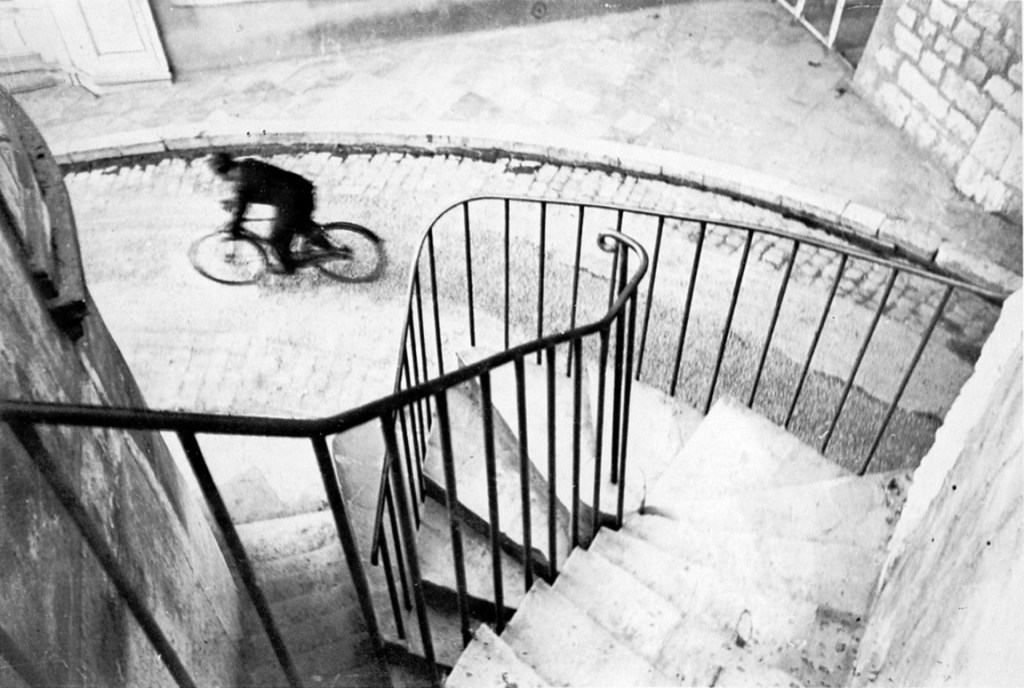
FRANCE. Marseille. The Alle du Prado. 1932. I was walking behind this man when all of a sudden he turned around.
He believed in composing his photographs in the viewfinder, not in the darkroom. He showcased this belief by having nearly all his photographs printed only at full-frame and completely free of any cropping or other darkroom manipulation. (Wikipedia from the NYTimes)
Take that Ansel Adams.
This is not a criticism of Mr. Adams.
NOT AT ALL.
Just recognition of the difference of the two.
Cartier-Bresson defined his work as ‘The Decisive Moment.’
Not, as might be guessed, that the photographer captured the decisive moment in history, the game winning hit, the great speech, the great debate or the second of assaianation.
But that the elements in the scene came together to create the decisive moment when the great photograph was there to be snapped.
Cartier-Bresson said, “There is a creative fraction of a second when you are taking a picture. Your eye must see a composition or an expression that life itself offers you, and you must know with intuition when to click the camera. That is the moment the photographer is creative,” he said. “Oop! The Moment! Once you miss it, it is gone forever.”
While Cartier-Bresson was a world famous photo journalist and had assignments to capture the powerful and famous of the world, so many of his photographs are of no one, no where and nothing special.
It is the moment that he captured.
The moment of any where life every day somewhere that made the photograph famous.
Cartier-Bresson famously was assigned to photograph the coronation of King George VI in 1936.
He returned with rolls of film of the crowds in London.
The people along the street.
The faces in the parks.
And without a single photograph of the new King.
I have to wonder what his images of life today would look like.
somethings important as life and death, are they not very important
I ran across this bit of prose in my reading last night.
It is from a C.S. Forester novel titled, ‘The Ship.“
At the moment in question, the Captain of HMS Artemis has given the orders that will take the ship into action against an enemy fleet of much greater strength.
The Captain reflects for a moment.
Forester writes;
“The Captain experienced a feeling of elation that was extraordinarly pleasant. He was a man who was profoundly interested in the art of living. Rembrandt gave him pleasure, so did the Fifth Symphony; so did bouillabaisse at Marseilles or southern cooking at New Orleans or a properly served Yorkshire pudding in the north of England; so did a pretty girl or an elegant woman; so did a successful winning hazard from a difficult position at billiards, or a Vienna coup at bridge; and so did success in battle. These were things that gilded the bitter pill of life which everyone had to swallow. They were important as life and death; not because they were very important, but because life and death were not very important.”
The pill of life is pretty bitter right now.
My wife asks over and over again, “How are people …”
Utility bills are suspended.
Rent payments held up.
Long long long lines at food banks.
Not much gilding to the bitter pill for too many people.
I can’t do much about that.
I am profoundly interested in the art of living.
I can do much about what I might find extraordinarily pleasant.
Are these things important?
Are they important as life or death?
Know what?
Maybe.
Maybe so.
Quoting Captain Augustus McCrae of the Texas Rangers, “It ain’t dying I’m talking about, it’s living.”
Weary to my bed Begin a journey in my head I find no quiet
I am working from home and lucky to be working from home.
No driving.
Actually been days since I drove anywhere.
I am working.
I get tired, very tired.
With all that is going on, weary is such a perfect word.
Bedtime comes, I read in bed for a minute and the eyes start to close.
And off to the land of Nod.
At least for a bit.
At some point in the night, I wake up.
I am not moving but my brain is speeding at a bazillion miles an hour.
At that awful hour of 3AM.
Ray Bradbury has been there.
In Something Wicked This Way Comes, Mr. Bradbury writes, “Oh God, midnight’s not bad, you wake and go back to sleep, one or two’s not bad, you toss but sleep again. Five or six in the morning, there’s hope, for dawn’s just under the horizon. But three, now, Christ, three A.M.! Doctors say the body’s at low tide then. The soul is out. The blood moves slow. You’re the nearest to dead you’ll ever be save dying. Sleep is a patch of death, but three in the morn, full wide-eyed staring, is living death! You dream with your eyes open.”
Hemingway writes of his mind and being able to choke it so he could sleep.
Not that I dare put myself in the same boat with Mr. Hemingway or Mr. Bradury, but that they are in the boat with me where we say “To work my mind, when body’s work’s expired“, as Mr. Shakespear put it.
Because Big Bill is also in the boat with us.
Big Bill lived and worked 300 years ago and was plagued with the sleepless nights and the overactive mind.
In his Sonnet XXVII, he writes; Weary with toil, I haste me to my bed, The dear repose for limbs with travel tired; But then begins a journey in my head, To work my mind, when body’s work’s expired: For then my thoughts, from far where I abide, Intend a zealous pilgrimage to thee, And keep my drooping eyelids open wide, Looking on darkness which the blind do see Save that my soul’s imaginary sight Presents thy shadow to my sightless view, Which, like a jewel hung in ghastly night, Makes black night beauteous and her old face new. Lo! thus, by day my limbs, by night my mind, For thee and for myself no quiet find.
All of us in the boat together.
All of us asking where is sleep.
It would take someone as wise as Solomon to answer.
Lucky for me, Solomon did.
In Proverbs, Solomon writes, “When you lie down, you will not be afraid; when you lie down, your sleep will be sweet.”
What is the secret to this sweet sleep?
“Do not let wisdom and understanding out of your sight, preserve sound judgment and discretion.” (Proverbs 3:19-21 NIV)
what was it like then to have lived through that time we here are there now
“On the morning of the 3d, we moved forward to the first position occupied on the 2d, and were formed the same, where we remained till about 3 p.m. Thence we were moved off by the right flank at double-quick to where the enemy was trying to pierce our center. The regiment was here detached, and sent to the support of the Second Division, Second Corps, where we assisted in repulsing the enemy, who had succeeded in breaking through a portion of their line.“*
So reads the report of Lt. Col. Edwin S. Pierce, commanding the 3rd Michigan Volunteer Infantry at the Battle of Gettysburg.
What he described came down in history known as ‘Pickett’s Charge’.
This is a first person eyewitness account of the one of the most famous and awful moments in United States history.
“The regiment was here detached, and sent to the support of the Second Division, Second Corps, where we assisted in repulsing the enemy, who had succeeded in breaking through a portion of their line“
Bruce Catton described the same scene, “
“For the next few minutes this irregular rectangle of ground, a hundred yards deep by two or three hundred yards wide, was the bloody cockpit of the whole war, the place where men on foot with guns in their hands would arrive at a verdict. In this rectangle there was little work by the artillery. The Confederate guns to the west could not fire into this place without hitting their own men, and the Union guns here were out of action. A regular army battery of six guns commanded by Lieutenant Alonzo Cushing had been posted just north of the trees; by the time the Confederates came up to close range, five of the six guns had been put out of action, and when Cushing got off a final shot from the one gun that remained, he was killed and most of the gun crew went down with him. The climax of Pickett’s charge was an infantry fight pure and simple.
It was fought out with unremitting fury. Some of Pickett’s men broke in across the stone wall and knelt amid Cushing’s idle guns to fire point-blank at the defending infantry. Some of the defenders found the fire too hot to bear and withdrew; on a narrow front, and for the moment, Pickett’s men had actually broken the Union line. If they could widen the break and hold on to the ground gained until help came, they would have the battle won.…“**
For us, looking back, it is Pickett’s Charge, the high water mark of the Confederacy.
To the men of the 3rd Michigan, it was another day at the office.
The Colonel of the 3rd Michigan, Byron R. Piece, a former Dentist from Grand Rapids, Michigan, had been wounded the day before.
His brother took over command of the regiment on July 2nd and led the regiment in a counter attack against the confederate assault on July 3rd.
After 3 days of fighting in the Battle of Gettysburg, Lt. Col. Pierce closed his report with the line, “In closing this report, I cannot particularize any of the officers or men”
In other word, we didn’t do anything special.
We just did what was expected.
We did what we had to do.
Lt. Col. Pierce went on, “I am proud to state that they did their duty without an exception.”
I am living through the Get Flu Pandemic of 2020.
I am living through history here and now.
How will I be judged by history?
I just want to find toilet paper to get through this.
I am not a health care provider.
I am not an emergency responder.
I think of what John Milton wrote back 1673.
“They also serve who only stand and wait.“
I can stand with the best of them.
I can wait with the worst.
I would be happy to be described as some one who “their duty without an exception.”
When I Consider How My Light is Spent
When I consider how my light is spent Ere half my days in this dark world and wide, And that one talent which is death to hide Lodg’d with me useless, though my soul more bent To serve therewith my Maker, and present My true account, lest he returning chide; “Doth God exact day-labour, light denied?” I fondly ask. But Patience to prevent That murmur, soon replies: “God doth not need Either man’s work or his own gifts; who best Bear his mild yoke, they serve him best. His state Is kingly. Thousands at his bidding speed And post o’er land and ocean without rest: They also serve who only stand and wait.”
John Milton, (1608–1674)
*Report of Lieutenant Colonel Edwin Pierce, 3rd Michigan Infantry, on the Battle of Gettysburg. HDQRS. THIRD REGIMENT MICHIGAN VOLUNTEERS, August 4, 1863. from OFFICIAL RECORDS: Series 1, vol 27, Part 1
** Catton, Bruce. Gettysburg: The Final Fury. Garden City, N.Y. : Doubleday, 1974
spring break broke this year but the trips we used to take memories, good, bad
As far back as I can remember and before that, I have taken a week off for Spring Break.
When I was a baby, 8th in a family of 11 kids, my family took off on Spring Break and did something, I am sure.
When I was in grade school, my older brother had married and moved to Washington, DC and my family would drive off and visit him and his wife, Judy.
We also got to tour Washington and the museums there.
Our family trips were memorable.
My Dad wanted a quick getaway the Friday night we got out of school.
Somehow my Mom packed up all our clothes and was ready.
The Friday night getaway meant we would be going to church somewhere that weekend so my Mom also had to pack Sunday clothes and shoes.
As it was Spring time (by calendar if not in fact) we all got some new spring clothes.
And SUCH CLOTHES.
NOTE: This was a later trip – maybe 1972, but the clothes … We were posing to look like Civil War Reunion group.
You had to grow up in the hippy era to understand what those clothes were like.
BOLD STRIPES.
BRIGHT COLORS.
INTERESTING … FLORAL DESIGNS.
For some reason it seems to me that we all got a new spring jacket and new sneakers.
And so we were off.
Mom and Dad and 8 or 9 kids or more, depending on the breaks, from babies to college age, packed into our Ford LTD Station Wagon.
Three in front, three or four in the middle, Mom in the middle, right hand door.
And the rest of us dumped in the back.
Not a seat belt in use.
My Dad wanted to do one thing once we got started.
MAKE TIME ON THE FREEWAY.
Maybe it was a World War 2 veteran thing.
Garrison Keillor also remembered that on family trips, his Dad wasn’t happy if they didn’t put 500 to 600 miles on the car each day.
One year my Dad came up with this great idea.
Instead of stopping for dinner along the way, we would eat in the car.
My Mom would make a picnic lunch of sandwiches and we would eat as we drove.
In a stroke of luck, my Dad discovered that our local KFC sold those 8 ounce cardboard cartons of milk.
The type of carton of milk we all got at school.
What could go wrong?
He stopped at the KFC the day before we left and bought out their supply.
The year I am thinking of, 1972, my Grandma came along and we would drop her off for a visit with my cousins in Kingston, NY.
The route we were taking took us through Detroit, across Canada to Niagara Falls, to Kingston and then down to Washington, DC and on the way home, stopping in Carlisle, Pennsylvania to see my brother Bobby and his wife, Jan.
According to Google Maps, a trip of 1,745 miles.
Friday arrived, school was over, we were on Spring Break and off we went.
We left about 4 o’clock.
When we got to Detroit, my Dad announced he was hungry and could use a sandwich.
And in his moment of glory he added, “And give me one of those milks.”
There was a rustle and bustle in the car as the lunch basket was opened up.
Understand that my Mom had certain ideas about eating.
Sandwiches in baggies were not passed out.
She got out paper plates and paper napkins and made up a plate for eveybody.
Each plate had a sandwich.
Of course Mom made a selection of sandwiches and there was much time spent in selecting what to eat.
My Mom also had the interesting habit of making sandwiches using raisin bread.
Which was fine if you were expecting it.
But it could be a surprise to get a PB&J with raisins if you didn’t know my Mom.
Anyway, we all got a plate with a sandwich, some grapes and celery sticks.
And a carton of milk.
All went well and by the time we crossed over the Ambassador Bridge to Canada, dinner was over.
“And no time lost!”, my Dad announced proudly as the trash was packed away.
A few hours later, we were coming up towards Niagara Falls, Ontario, my little brother Steve, who we called Eddie, leaned over from the back of the station wagon to the middle seat.
“Mom?’, he said.
“Mom, I feel … sick”
Then he barfed.
Thinking about this later, I think Eddie must have tried to avert his head from my Mom as he spewed an arc of vomitous mass across the middle seat into the back of the wagon.
Talk about a bomb going off.
Dad got over and off the road.
Somehow the car was cleaned up enough to go on.
Really what else could you do?
Middle of the night in Ontario with a car full of people.
A car full of people now all acutely aware of their stomachs and smells.
Smell of well, you know, AND the smell of slightly sour milk covered cardboard from the trash.
On we went through the night to our destination of St. Catherine’s, Ontario.
I can’t remember much more of that night but the next morning we drove into Niagara Falls, Ontario.
My Dad found a 1 hour dry cleaner for our new coats and we went off to breakfast at some place overlooking the falls.
Where my little brother Al, threw up.
Another great commotion but with Canadian accents this time.
We got through that and for the most part we made it to Kingston, NY without incident.
It wasn’t until I was married and had in-laws that would come over for dinner that I understood what it meant to host a visit from a traveling horde like my family.
What do you do when 10 or 11 people drop out of sky into your dining room.
My Dear Aunt Mernie was ready for us with a lasagna dinner.
We had recovered enough, we were excited enough at seeing our cousins and the thought of dropping Grandma off for a month that we had a great visit.
Then off to Washington.
Again this part of the trip was without inncident.
We got settled in a hotel and went over to my brother Paul’s apartment.
Now just 10 people, with Grandma left behind, my sister-in-law Judy was all set for us.
We sat down to a lasagna dinner.
The plan the next morning was to stop for a quick breakfast with Paul and Judy and then into Washington, DC and the Smithsonian!
Moon Rocks!
Lincoln’s clothes!
Washington’s teeth!
I remember feeling a bit off that morning and stuck with a little glass of OJ for breakfast.
We drive into the city and wonder of wonders found a parking place on the Mall about 5 blocks from the Smithsonian.
It was a guidebook to Washington morning.
Sunny, bright and clear.
Richard Nixon was right over there in the White House.
We were right in the heart of DC.
It was real.
It was almost too much.
We walked over and went in the Museum of American History.
This building was packed with anything and everything about you would want to see.
We ran in and stopped at the first thing inside.
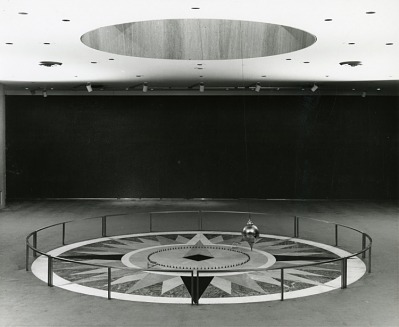
If you have been there, it was a giant pendulum swinging back in forth to demonstrate the rotation of the earth.
Placed directly in front of the original Star Spangled Banner from Fort McHenry, you couldn’t miss it.
The pendulum swung back and forth over a circle that was lined with little red blocks.
Every five minutes or so, the pendulum would move enough to knock over a block.
With the museum right there, after all that trip, we just stood there, watching these blocks fall.
(I learned today, the Foucault Pendulum at the Smithsonian was removed in 1998)
All we had gone through to get there and us kids wouldn’t move on.
It was a museum equivalent of watching cement dry.
We were mesmerized.
Back and forth, back and forth the pendulum swung.
I became more aware of my stomach.
My Dad dragged us away and we moved through the displays.
I have a very distinct memory of being in what was called, ‘The Hall of Elections”.
It was at this moment that my stomach decided it had had enough.
I broke out in a sweat and said to my Dad, “I think I am going to be sick.”
My legs went rubbery and a went down on one knee.
My Dad was used to me ‘telling stories’ as it was called in my family, but he took one look at my face and ran off.
To this day, I don’t know if he was running away from me, but I stood up and ran after him.
He went up an escalator and I said to myself, “NO NO NO.”
Besides the motion, I could not figure out how, if I barfed on the escalator, would they clean it?
Scrub on the way down, then run to the top and clean some more on the way down?
Then it happened and one my family legends was written.
My brothers and sisters had followed me and my Dad as we ran away.
I am not sure if they heard me tell Dad I was sick or not but this chase through the Museum promised to be more excited than anything you could see on display.
I was halfway up the escalator when my stomach heaved.
“NO”, I said to myself.
“THIS WILL NOT HAPPEN!”
I shut my jaws and forced the contents of my stomach back down.
It came right back up.
My body convulsed.
I wanted to cough.
I was choking.
I stood firm and with both hands, all ten fingers, I grabbed my lips and forced them together.
Try it.
Try it and look in the mirror.
My stomach heaved and I held my mouth shut and forced it back down.
I look across at the down escalator and all I remember is all these faces with eyes as big as baseballs, staring at me in horror.
I didn’t care.
My stomach heaved and through my lips, a jet a orange juice spit out for a second, but went right down the sleeve of my coat.
I thought it was going to come out my ears.
I swallowed again and made to the top to see my Dad standing by a Men’s Room door and waving.
I made to the stall with fingers still locked over my lips.
For the rest of my life my brothers and sisters would yell at me, “Hey MIKE” and close their lips together with their fingers and laugh and laugh.
That was the end of that day in Washington.
Back at the hotel, I spent the day with my Mom getting sick over and over again.
The rest of the family went to some family fun park in the Maryland area.
Fun maybe for them, but not a visit to Washington.
I recovered nicely by the next day and I led the charge back downtown to prove I was no longer sick.
After another day or two in Washington it was off to Carlisle, Pennsylvania, where my brother Bobby was stationed during his time in the US Army.
He and his wife, Janet, had an apartment there and it is where my niece Joann was born.
We arrived just in time for what?
A lasagna dinner!
After that, it was back home.
It seems to me that the rest of the trip was uneventful.
I do think several of my siblings got ‘queasy’ along the way and maybe skipped some restaurant meals to just sit in the car for a bit.
But no more vomiting that I can recall.
I have to admit that I might be confusing some memories with another family trip out east where we went to Hershey, Pennsylvania and Dad ordered the ‘ASSORTMENT BOX’ at the Hershey Factory store.
He walked away with a box of 12 different candy bars, Hershey Bars, Hershey’s with almonds, and such.
6 of each bar.
72 CANDY BARS!.
These went into the back of the station wagon in summer time and it seems like a lot of motion sickness set in on that trip as well.
We survived.
Survived to make other family trips.
Two things do stand out in my memory.
After we got home, my Mom checked up on the people we had visited along the way.
We learned that at all our stopping places, after we left, everyone came down the stomach flu.
We blazed a trail of barfing across the eastern United States.
The other thing is that for most of my life after that, I was plagued with what I called, ‘Barfphobia’.



 No Haiku For You