plan, plan, plan, plan, plan plan, plan, plan, plan, plan, plan, then hide in Samarra
The Appointment in Samarra
There was a merchant in Bagdad who sent his servant to market to buy provisions and in a little while the servant came back, white and trembling, and said, Master, just now when I was in the marketplace I was jostled by a woman in the crowd and when I turned I saw it was Death that jostled me.
She looked at me and made a threatening gesture, now, lend me your horse, and I will ride away from this city and avoid my fate.
I will go to Samarra and there Death will not find me.
The merchant lent him his horse, and the servant mounted it, and he dug his spurs in its flanks and as fast as the horse could gallop he went.
Then the merchant went down to the marketplace and he saw me standing in the crowd and he came to me and said, Why did you make a threating getsture to my servant when you saw him this morning?
That was not a threatening gesture, I said, it was only a start of surprise.
I was astonished to see him in Bagdad, for I had an appointment with him tonight … in Samarra.
( The speaker is Death – as retold by W. Somerset Maugham – 1933)
My glasses, as always, were murky and splattered with gunk.
I took them off to clean them up with my shirt tail so I could get a better look at the painting.
Digression: I love 100% long sleeve cotton shirts that I wear untucked. I wear them untucked just to have something handy with which to clean my glasses.
As I was polishing my glasses, I leaned in close to the painting.
History of Art was my minor in college.
I enjoyed the lectures and the stories about the painters and paintings.
I had a hard time going along with the concept that art could be assigned to genre and schools and such.
I found out the History of Art was a field of study conceived and taught first in Germany.
Then it all made sense.
Can’t have all this art just lying around, there must be order!
But again I digress.
One of the professors I had took the class on a tour of the Detroit Institute of Art.
And he explained ‘How to go to an art museum.’
Perspective: Sit on the floor about 10 to 15 feet in front of the work to get the artist’s perspective. (Doggone it but he was right).
Light: You MUST visit any museum three times. In the morning, for morning light. In the afternoon for afternoon light and at night for electric light as the art changes. (Doggone it but he was right again).
AND MOST IMPORTANTLY, The Guards: He said to embrace that we were students of art, not just visitors. When we entered a gallery, we should first walk up to any guard and introduce yourself and just let them know you were a student.
On this day, I had introduced myself to the guard and said I was an art student.
He turned ever so slowly and looked me in the eye and just barely nodded.
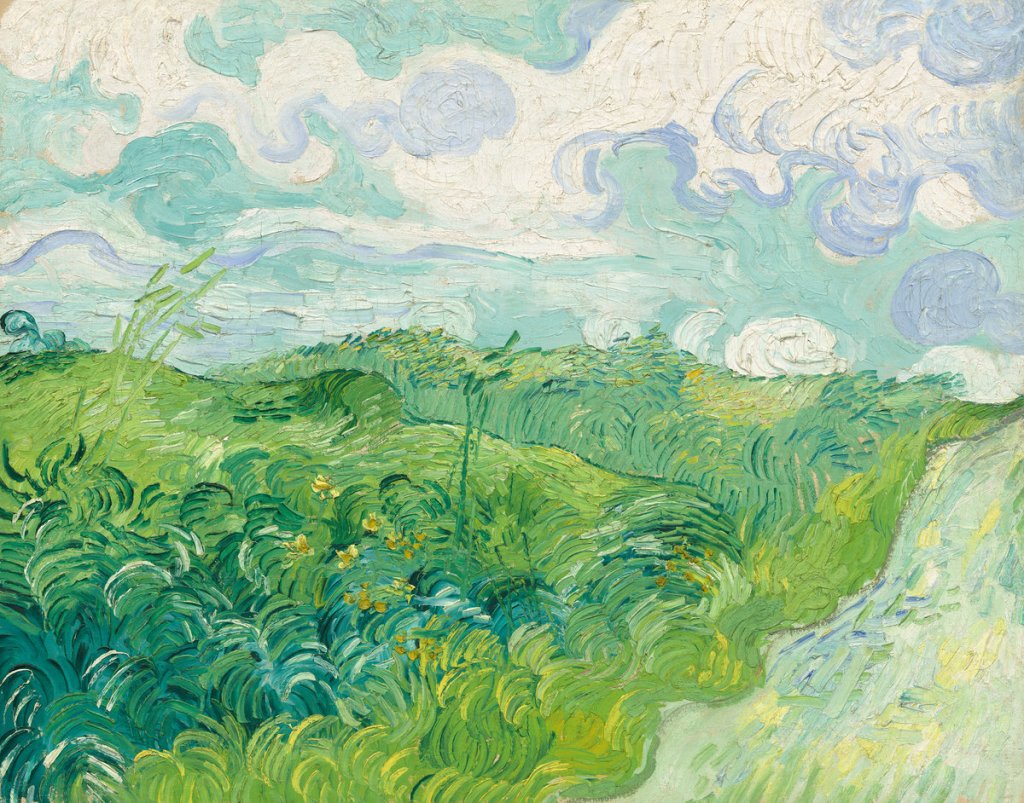
And in I went and found myself in front the Van Gogh, polishing my glasses.
I am very very very near sighted.
I can see my hand in front of face at about 3 inches.
BUT the detail I see at the distance just drives me nuts as it lets me realize just how bad my eyes are.
Anyway, as I polished my glasses, I leaned in closer and closer to bring the painting into focus.
When I could see the painting clearly, I was so close, I was probably seeing a section of the painting that that was 4 by 6 inches.
My brain went click or something.
In that 4 x 6 inch section of the painting, viewed from about 3 inches away, with my glasses off, focus was so sharp, there was as much detail in the entire painting.
I could see brush stokes on brush strokes.
I could see the edges of a palate knife.
I could see lines of SINGLE HAIR of a brush.
I could could whorls and swirls of oil paint that looped and hooked like white cap waves on Lake Michigan.
Layer upon layer of color threads and trails.
I felt I was inside the painting.
I swear I could look UP at the peaks of oil paint.
Surrounded by Vincent’s impressions of the view of the field.
The painting is big.
About 2 feet by 3 feet.
I had to see the entire thing.
And I slowly moved over the entire surface from 3 inches away.
My eyes must have been where Vincent’s hand had been.
I was gone.
I was gone from the world that the art gallery was in.
I am not sure where I was.
Seems like I stopped breathing but I could not have as I stood there for about 20 minutes.
Like one of those time-space sequences in a movie, this moment came to an end and I was sucked back out of the painting in a tunnel of streams of light.
I straightened up and stepped back.
And came back into to this world.
I put my glasses back on.
Looked around.
That guard was right behind me.
The entire time, he had been guiding people around me.
He let me have those moments.
Maybe he knew I had left the room.
Maybe he had seen the effect on others.
I caught his eye and nodded.
He nodded back.
Words were not necessary.
Not sure a week goes by that I don’t think of this moment.
easy to live in the wreckage of the future each day for itself
I was listening to Louise Penny’s Long Way Home in the Chief Inspector Gamache series and she used the phrase, ‘living in the wreckage of the future.”
The phrase has stuck in my brain.
Often, the wreckage of the future is NOT IMAGINED.
Life can be a train wreck waiting to happen.
And the trains are in motion and they are on tracks and the tracks cannot be changed.
We would be foolish to ignore what is coming.
Still.
I am reminded of stories of the days of railroading when a dispatcher would realize that a train wreck really was going to happen.
Two trains routed onto the same track and heading towards each other.
No way to communicate with either trains.
No way to stop it.
These trains were going to wreck.
The only thing a dispatcher could do was put together a rescue train with medical supplies and personel and send it on the way to where ever the accident did take place.
And deal with the wreckage of the future.
There was a chance that the engineers might see each oncoming train.
Maybe the point of meeting would be on a straightaway across a prairie and the engineers could stop.
The emergency train would be sent out and the dispatcher would hope for the best.
Lots of trains in my life right now.
Lot of those looking to be in a wreck.
I will be ready but hope for the best.
In the movie, The Magnificent Seven, Steve McQueen says to Yul Brenner, “did you hear about the man who fell of the 10 story building? All the way down, he kept saying, so far, so good.”
But I have to say none of the place made my list of ‘Go To Placs fo 2020″.
It wasn’t that the list included Albania, Medellin, and Rwanda (Rwanda???).
Or that the 1st place in the USA listed was Athens, Georgia.
I have no interest in these places.
I admit I am not a traveler.
Never had a passport.
Overall, looking at this list, I don’t know any one there.
When I think of places, I think of people.
Mitch Albom wrote today in The Detroit Free Press, “Have you ever known someone by the place you always saw them? Someone so delightful, they colored your view of the city or country where you met? If so, then you know the place is not the same when the face is gone.“
Mitch writes a delightful column about, Margaret, a woman he knew in Ireland.
I hope she was real and not made up.
Mitch has done it before.
Sorry to be pithy but I remember.
As would have been said but in my college classes, his work has a suspect animus.
ANYWAY.
Family and friends.
Now I have friends who they themselves have friends and family in these exotic places.
I think that is great.
I have friends who DO love to travel and see new things or old things anew.
I think that is great.
But me?
Not a traveler.
And I don’t fell like I am missing anything.
Now if we are talking about travelling for the food.
I can understand that.
But I live Gwinnett County, Georgia.
All the world’s people have moved to Gwinnett.
The world’s food has come to me.
After getting coffee at a Guayoyo Coffee & Bakery, a Venezuelan Bakery which was next to the Indian Restaurant where we had lunch and deciding not to go across the street for Korean Chai, I thought, why do I need to travel?
weak upper impulse lingering secondary fairly pleasant start
Ernie Hemingway could not have been a meteorologist.
Mr. Hemingway’s prose can be described in the one word, terse.
A meteorologist’s prose can be describe in the one word, verbose.
Weather forecasts may be the best example of the use of descriptive adjectives in modern english writing.
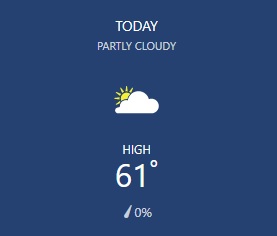
Consider today’s forecast from the National Weather Service.
SHORT TERM /Today through Sunday/…
A lingering secondary weak upper impulse is allowing for some isolated light rain/drizzle potential mainly in portions of central GA early this morning, otherwise should transition to NW flow aloft and dry Saturday on tap. Some continued mid level moisture especially in central GA could keep some cloud coverage hanging around today. Should be a fairly pleasant start to the weekend with afternoon highs mostly in the low to mid 60s.
Surface high center sliding into New England this evening will result in a CAD wedge building in for Sunday across the area. We can expect a shift to cooler temps (about 10 degrees lower than Saturday across north GA), increased easterly gradient winds, and some low level moisture overrunning/isentropic upglide causing increased cloud coverage and some return of afternoon shower potential in parts of the south and west. Ascent and late shower potential could also be aided by a weak upper shortwave.
Baker
LONG TERM /Sunday Night through Friday/…
The long term period begins on Sunday night with a wedge still in place across northeast Georgia. As southwest flow advects moisture over the wedge, chances for showers will continue into the early hours on Monday. Have included slight chance pops for Sunday afternoon with increasing chances Sunday night into Monday afternoon, as the wedge breaks down. A large longwave trough will push a strong cold front towards the area on Tuesday into Wednesday with the arrival of the front during the day on Wednesday. Have included chance pops across much of the area with likely pops across portions of northern Georgia in addition to the mountains. The highest QPF amounts for Monday through Wednesday look to be across far northern Georgia, around 1 to 2 inches with around a half inch or less further south. In addition, models are showing some slight differences on the backside of this system with the GFS showing another shortwave trough developing and crossing the local forecast area late Wednesday into Thursday and the ECMWF, while still showing the shortwave trough, clears precip from the local forecast area by Thursday and takes the trough much further south of the area. Overall, decided to trend on the drier side for pops in this time period, with slight chance to chance pops Wednesday afternoon and clearing across the area on Thursday.
Post frontal passage, high pressure will build into the area at the surface, providing dry weather for Thursday. By Friday, chances for precipitation will increase again as models show a developing surface low in the Gulf moving towards the local forecast area on Friday and Saturday. Although models are showing some differences in timing, have included chance pops for Friday through the early weekend.
High temperatures on Monday and Tuesday will be about 5 to 15 degrees above average in the 60s and 70s, returning to the 40s and 50s through the rest of the extended. Overnight lows Tuesday morning will be very warm in the 50s and 60s, around 20 to 25 degrees above average. Otherwise, lows through the rest of the extended are expected to be in the 30s and 40s.
Reaves
Notice in the 2nd paragraph the abbreviation CAD.
CAD stands for ” Cold Air Damming. The phenomenon in which a low-level cold air mass is trapped topographically. Often, this cold air is entrenched on the east side of mountainous terrain. Cold Air Damming often implies that the trapped cold air mass is influencing the dynamics of the overlying air mass, e.g. in an overrunning scenario. Effects on the weather may include cold temperatures, freezing precipitation, and extensive cloud cover.”
Good Grief.
I can see why they used the abbreviation.
These are some of the words used in just the short term forecast.
lingering secondary weak upper isolated light mainly early mid especially fairly pleasant mostly low mid high cooler lower increased easterly gradient overrunning isentropic upglide
Impressive list.
Notice also the names Baker and Reeves and the end of the forecasts.
Are these the meteorologist who wrote these forecasts?
Did they learn this style in meteorology class?
Is there a special thesaurus for weather modifiers?
At the end, what do want to know?
I take my hat off to these people.
I salute these people.
I also recall once seeing my good friend George Lessens come into the newsroom after a particularity wordy forecast and I yelled, “oh come on. You guys make all the stuff up!”
Even George joined in as everyone in the newsroom laughed.

 No Haiku For You