Down and out semi poet who is down and out in the Low Country of South Carolina after living in Atlanta which is not to be confused with the south, the old south or the new south. Atlanta was a global metropolis with all the pluses and minuses that comes with that. The low country, low because it is low, 8 feet above sea level, is not Podunk but once you get to Podunk, turn left. I try to chronicle a small part of all that through my daily haiku for you.
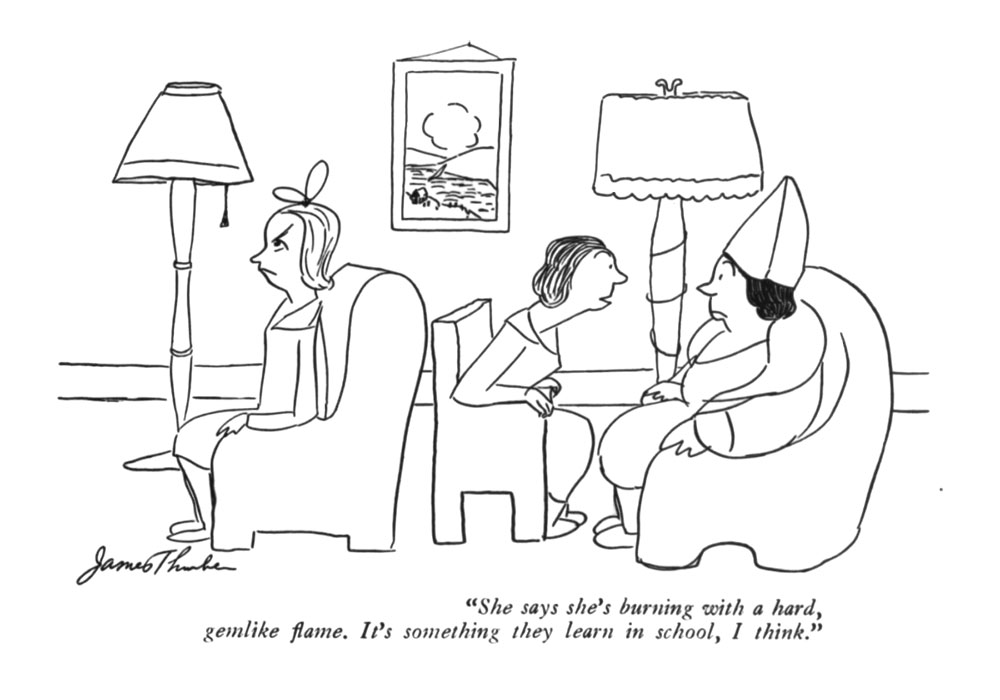
burning with a hard, gemlike flame – it’s something they learn in school, I think
First published on June 18th, 1938, in the New Yorker Magazine.
The drawing was republished in one of the editions of Thurber’s book, Men Women and Dogs with the caption:
It’s a strange mood she’s in, kind of a cross between Baby Doll and Elizabeth Barrett Browning.
No explanation for the change but it would be difficult to get into a haiku.
According to Wikipedia: Baby Doll is a 1956 American black comedy film directed by Elia Kazan and starring Carroll Baker, Karl Malden and Eli Wallach. It was produced by Kazan and Tennessee Williams, and adapted by Williams from two of his own one-act plays: 27 Wagons Full of Cotton and The Unsatisfactory Supper. The plot focuses on a feud between two rival cotton gin owners in rural Mississippi.
Filmed in Mississippi in late 1955, Baby Doll was released in December 1956. It provoked significant controversy, mostly because of its implied sexual themes, and the National Legion of Decency condemned the film.
WOW!
Kind of a cross between Baby Doll and Elizabeth Barrett Browning or burning with a hard, gemlike flame that might be something learned in school.
Needlework and computer coding might seem to be incongruous pursuits, but for the Dutch artist Anna Lucia Goense, the combination has provided infinite creative possibilities.
“If you look at cross-stitching or working with a loom or even knitting patterns, they are always binary systems on grids,” said Ms. Goense, 33, who is known professionally as Anna Lucia. Her focus is generative art, a process that involves designing systems, manipulating parameters and fine-tuning algorithms to create artworks that can range from browser-based animations to textiles such as quilts and embroidered fabrics.
Along with the concept itself of art from computer code, I had to admire the role of syllables in that sentence:
… generative art, a process that involves designing systems, manipulating parameters and fine-tuning algorithms to create artworks that can range from browser-based animations to textiles such as quilts and embroidered fabrics.
facing too much or … facing too little water or … or … facing both
Based on the passage:
The Nasa researchers produced the updated statistics at the request of the Oxford-based research organisation Global Water Intelligence, whose head, Christopher Gasson, said water companies were in the firing line of climate change – facing too much water or too little water – or both.
He said most water companies were completely unprepared to cope with the changes under way. “This is extremely scary,” he said.
same routine goes on each day there is not much for me to write about
No surprise that on Father’s Day I would be thinking about Dad and for inspiration, I turned to the letters he wrote home to his (then) girlfriend (now my Mom) during World War 2 when he was a Captain in the Army of the United States (not to be confused with the United States Army) serving as a Dentist in the Medical Detachment of the 12 Corps Headquarters unit.
It took a lot to impress my Dad.
In one letter, he opened with:
The same routine goes on by each day and so there is not much for me to write about. The weather stays the same, sometimes good and sometimes bad but never very warm.
The letter is from England and is dated June 12, 1944.
Almost exactly 81 years ago today.
Six days after D-Day.
Wikipedia states: The Normandy landings were the landing operations and associated airborne operations on 6 June 1944 of the Allied invasion of Normandy in Operation Overlord during the Second World War. Codenamed Operation Neptune and often referred to as D-Day (after the military term), it is the largest seaborne invasion in history. The operation began the liberation of France, and the rest of Western Europe, and laid the foundations of the Allied victory on the Western Front.
Six days later, Dad is writing:
The same routine goes on by each day and so there is not much for me to write about.
Boy, Howdy! It took a lot to impress my Dad.
What did impress Dad?
What did he write about when not writing about being 20 miles away from the largest seaborne invasion in history?
We had a good dinner of Roast Pork, mashed potatoes, gravy, lettuce, carrots and peas and some good cake.
Dad always liked good cake.
Late in his life, Dad had a problem with diabetes and had to watch his sugar intake.
Once Mom baked a flat cake and after dinner, she asked Dad if he wanted a piece for dessert.
Dad said yes and I was standing in the kitchen so Mom told me to cut one of the pieces of cake in half for Dad.
I asked Dad which half he wanted and he said in a very sad and woe-is-me voice, “The one with the most frosting.”
I looked at the cake and took the knife and cut the piece of cake in half parallel to the cake pan so that his slice had ALL the frosting on top.
Mom shook her head but Dad said, “Good boy!”
After his dinner of Roast Pork, mashed potatoes, gravy, lettuce, carrots and peas and some good cake, sweets were still on Dad’s mind and he wrote:
I would like to have you send me some more of that candy from Steketees, you know what type I mean. It really goes good around here. Everybody likes it and when I get a box like that there is enough so that we can all enjoy it.
Steketee’s was one of the three big department stores (along with Wurzburg’s and Herpleshimer’s that didn’t survive the mall era) in Grand Rapids, Michigan and they were famous for their Candy and Nut counter.
All things considered, Dad had a good World War 2.
He was in the army for just under 3 years with about half of that time in Europe and for the most part was focused on getting out and coming home.
I point out that in all of Dad’s letters, starting in the summer of 1942, NOT ONCE does Dad even question that the Germans would be beaten and when that was done, he would go home.
As I said, Dad was in the 12th Corps which was in Patton’s Third Army.
If you have ever seen the movie Patton, that opening speech was addressed to the Third Army so in a way, it was addressed to my Dad.
At the end of the speech, the Patton played by George C. Scott, closes with:
Now, there’s one thing that you men will be able to say when you get back home, and you may thank God for it.
Thirty years from now when you’re sitting around your fireside with your grandson on your knee, and he asks you, “What did you do in the great World War II?” — you won’t have to say, “Well, I shoveled shit in Louisiana.”
Well, Dad didn’t have to say that.
Nope.
He was in England eating Roast Pork, mashed potatoes, gravy, lettuce, carrots and peas and some good cake and thinking of candy from Steketee’s.
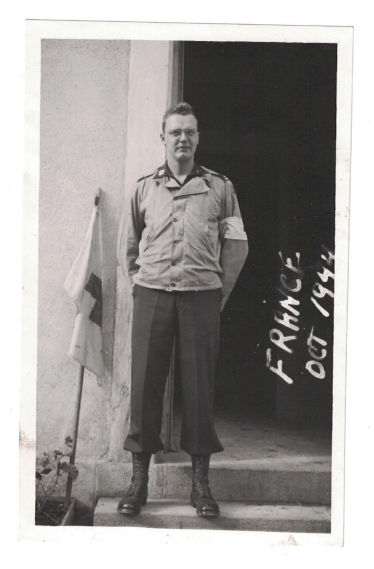
Captain R.P. Hoffman – Oct, 1944 (somewhere in France)
flag of stars, of man! sure and steady step, passing highest flags of kings
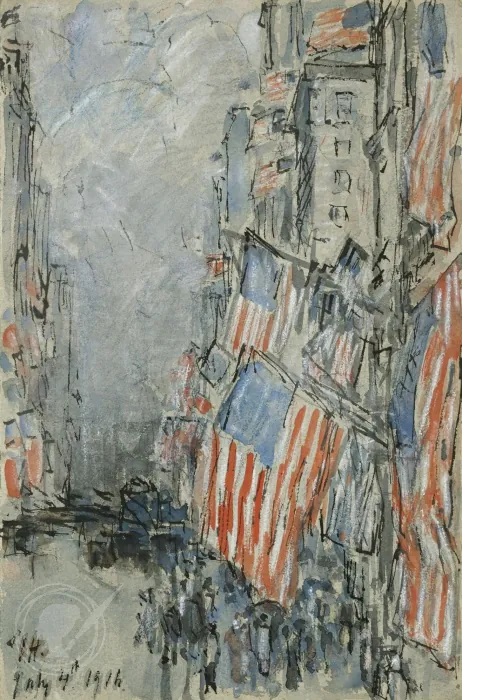
“Flag Day, Fifth Avenue, July 4th 1916” by Frederick Childe Hassam.
FLAG of stars! thick-sprinkled bunting! Long yet your road, fateful flag!—long yet your road, and lined with bloody death! For the prize I see at issue, at last is the world! All its ships and shores I see, interwoven with your threads, greedy banner! —Dream’d again the flags of kings, highest borne, to flaunt unrivall’d? O hasten, flag of man! O with sure and steady step, passing highest flags of kings, Walk supreme to the heavens, mighty symbol—run up above them all, Flag of stars! thick sprinkled bunting!
Flag of Stars By Walt Whitman as printed in Walt Whitman: The Complete poetry and selected prose and letters, London, The Nonesuch Press, 1964